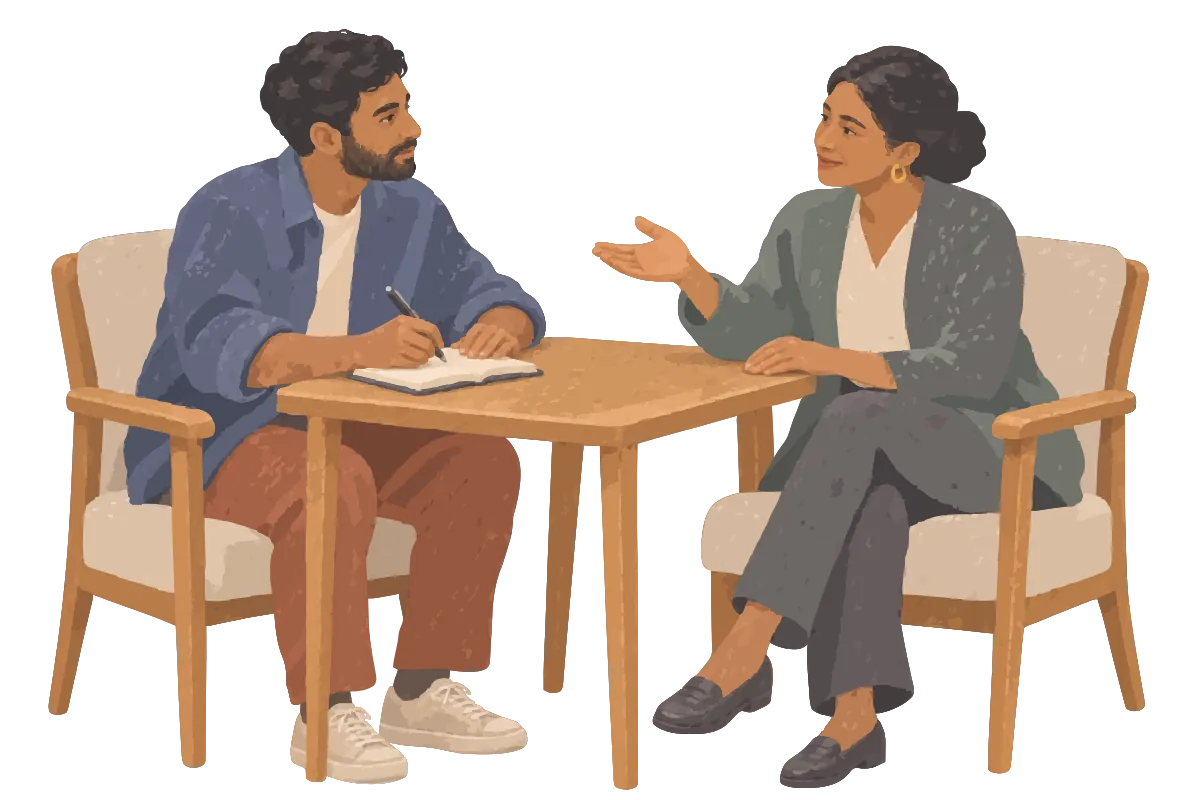
What therapy for people pleasing and assertiveness involves
Therapy for people pleasing can help you understand why you often put other people's wishes ahead of your own and learn to express your feelings, preferences and needs, even when doing so feels uncomfortable. Much of this work involves assertiveness: communicating honestly and directly while respecting yourself and the other person.
A treatment workbook from the Substance Abuse and Mental Health Services Administration (SAMHSA) describes the differences between three communication styles. Passive communication gives less weight to your own needs, aggressive communication disregards the needs of others, and assertive communication respects both. The workbook also explains that these are learned behaviors rather than fixed personality traits. With support and repeated practice, you can learn different ways of responding.
Being considerate of others is different from feeling unable to disappoint them. People pleasing describes a pattern in which agreeing, helping or smoothing over disagreements can feel more like an obligation than a choice. You may find yourself accepting requests before considering what you want. Over time, this pattern may contribute to exhaustion, resentment, difficulties maintaining balanced relationships and uncertainty about your own preferences.
A therapist can help you understand how this pattern developed, recognize the situations that bring it out and rehearse different responses. Assertiveness does not require you to confront someone when doing so could put you at risk. Your circumstances matter when deciding how to communicate. You can find a therapist who works with assertiveness and contact them directly to discuss the difficulties you are experiencing.
If you are in emotional distress or thinking about suicide, you can call or text 988 to contact the 988 Suicide & Crisis Lifeline. If you or someone else is in immediate danger, call 911.
Signs of people pleasing and when to consider therapy
Most people compromise or accommodate others from time to time. People pleasing may become difficult to manage when you repeatedly set aside your own needs, feel unable to refuse requests or experience considerable distress after expressing a preference. You might recognize some of these patterns:
- Saying yes to requests before considering what you have time or energy to do, then feeling trapped or resentful.
- Apologizing frequently, including for things that are not your responsibility.
- Finding it difficult to disagree, even about everyday decisions such as where to eat.
- Feeling anxious or guilty for a long time after declining a request.
- Paying close attention to other people's moods and changing your behavior to avoid upsetting them.
- Struggling to identify or express what you want when someone asks.
- Taking on additional work because refusing a request feels uncomfortable.
- Maintaining friendships or relationships in which your own needs receive little attention.
Consider speaking with a therapist if these patterns leave you exhausted, affect your relationships or interfere with your work, rest or emotional well-being. You do not need to wait until your difficulties become severe. Therapy may also be helpful if you experience considerable anxiety, persistent low mood or fear associated with previous relationships in which expressing your needs felt unsafe.
People pleasing can overlap with difficulties establishing personal boundaries and maintaining self-esteem. You may understand your limits intellectually but struggle to communicate them, particularly with someone whose approval matters to you. A therapist can help you explore that difference without treating your kindness or concern for others as a problem.
What causes people pleasing?
There is rarely a single explanation for people pleasing. Therapists may explore several influences, including your early relationships, present circumstances and beliefs about what happens when you disappoint someone.
- Early family experiences. You may have learned that being agreeable, quiet or helpful brought approval or reduced tension at home. Those expectations can continue to influence adult relationships.
- Unpredictable relationships. If you lived with frequent arguments, unpredictable reactions or difficult family circumstances, paying close attention to other people's moods may have helped you respond to uncertainty.
- Traumatic experiences. Some people use the term 'fawn response' to describe attempts to appease someone who might cause harm. It is an informal descriptive term, not a clinical diagnosis or a separate mental health disorder. Appeasing someone does not necessarily indicate a history of trauma.
- Cultural and family expectations. Expectations about gender, family responsibilities, obedience or caregiving can influence how comfortable you feel expressing your own preferences. Valuing cooperation and family relationships is not itself a problem.
- Fear of rejection. You may worry that expressing a different opinion will result in criticism, embarrassment, conflict or the loss of a relationship.
- Beliefs about your own worth. If you associate being valued with being helpful or available, declining requests may feel like a threat to your relationships or sense of identity.
Exploring these influences is not about assigning blame or assuming that every difficulty originates in childhood. It can help you understand why certain responses developed, recognize where they continue to protect you and consider where a different response may better serve your needs.
Assertiveness training and other therapies for people pleasing
Therapy for people pleasing may involve learning communication skills, examining beliefs about relationships or understanding experiences that have made expressing your needs difficult. The approaches a therapist recommends will depend on your circumstances and what you would like to change.
Cognitive behavioral therapy (CBT)
CBT for assertiveness examines the thoughts and assumptions that make speaking up feel difficult, such as fearing that disagreement will lead to rejection or believing that a considerate person should never disappoint anyone. A therapist may help you examine these beliefs and test them through manageable exercises in situations where you feel comfortable doing so. The National Institute of Mental Health explains that psychotherapy can help people develop social and communication skills and change unhelpful patterns of behavior. Understanding how CBT works may help you decide whether this approach suits your needs.
Assertiveness training
Assertiveness training is a structured approach to developing communication skills. A therapist may demonstrate different responses, help you rehearse conversations and offer feedback. Exercises can include declining requests, expressing disagreement, responding to criticism and asking for help. Some assertiveness training programs are delivered individually, while others involve group exercises and discussions.
Research findings should be understood in the context of the people who participated. One study involving high school students found that assertiveness training reduced stress and anxiety scores, while changes in depression scores were not statistically significant. These findings do not establish that everyone will experience similar benefits. Researchers have also proposed broader models of assertiveness that consider emotional, behavioral and mental experiences alongside interpersonal communication.
Approaches that explore earlier relationships
Psychodynamic therapy, schema therapy and attachment-focused approaches may help you examine how earlier relationships influence your expectations of yourself and others. This work may be relevant if you repeatedly feel responsible for other people's happiness or fear losing relationships when you express your needs.
Acceptance and mindfulness-based approaches
Acceptance-based approaches may help you respond differently to uncomfortable feelings and make decisions that reflect your values. Mindfulness exercises can help you become more aware of thoughts, emotions and automatic responses before acting on them. The aim is not to eliminate every uncomfortable feeling associated with saying no.
Group therapy
Group therapy can provide opportunities to rehearse communication skills, receive feedback and observe how others approach similar difficulties. A therapist can discuss whether individual sessions, group sessions or a combination would suit your circumstances and comfort level.
If you are also experiencing significant anxiety or persistent low mood, a qualified prescriber can discuss medication options for those difficulties.
Assertive communication skills you can learn in therapy
Assertive communication involves expressing your needs, feelings and opinions while respecting the other person's right to have their own. A therapist may help you develop the following skills through discussion, demonstration and repeated practice.
- Using "I" statements. Describe your experience and make a clear request. For example, "I feel overwhelmed when plans change at the last minute, and I need more notice." This communicates your concern without making a personal accusation.
- Taking time before responding. Saying "Let me check and get back to you" gives you time to consider your commitments, preferences and energy before agreeing.
- Declining a request clearly. A response such as "No, I can't this weekend" may be enough. You can provide an explanation if you choose, but a lengthy apology is not always necessary.
- Repeating your response calmly. Sometimes called the broken record technique, this involves restating your decision without repeatedly defending it when another person continues asking.
- Offering an alternative by choice. You might say, "I can't do Friday, but I could help on Monday morning," when you genuinely want to offer another arrangement.
- Making direct requests. Practice expressing what you would like, such as asking for help with household responsibilities, discussing your workload or requesting some time to yourself.
- Allowing uncomfortable feelings. Notice guilt or anxiety after setting a limit. Consider whether you need to reconsider your decision or are experiencing discomfort because expressing your needs feels unfamiliar.
For disagreements that require more discussion, the SAMHSA workbook describes a five-step conflict resolution model. This involves clarifying what happened, recognizing your emotional response, considering the consequences, deciding if a discussion would be worthwhile and arranging a conversation about the difficulty and possible ways forward.
Deciding whether to discuss a disagreement is an important part of this model. Assertiveness does not mean addressing every criticism or persuading someone to agree with you. If another person responds to limits with intimidation, threats or controlling behavior, repeated confrontation may be unsafe. A therapist can help you consider your safety and other available options.
What to expect from therapy sessions for people pleasing
During an initial session, a therapist may ask where people pleasing affects you most, such as at work, with family, with a partner or in friendships. They may explore how often it happens, what you fear might happen if you respond differently and how the pattern affects your emotional well-being. Questions about earlier relationships may also arise, although you do not need to discuss experiences before you feel ready. Knowing what to expect from a first session may help you feel more prepared for that conversation.
Therapists sometimes notice that the difficulty a person experiences in other relationships also appears during therapy. You might agree with an interpretation that does not feel right, apologize repeatedly or worry about disappointing your therapist by not completing an exercise. A therapist may gently explore these responses with you and encourage you to express your preferences. You are entitled to disagree, ask questions or explain that an exercise does not suit you.
Depending on your needs and the approach you agree on, later sessions may involve:
- Identifying situations in the coming week where you would like to communicate differently and considering how you might respond.
- Rehearsing conversations with your therapist and discussing which responses feel comfortable, realistic and appropriate.
- Exploring guilt, anxiety or self-criticism after expressing a limit and deciding how to respond to those feelings.
- Identifying your preferences, needs and values, particularly if you have spent considerable time prioritizing other people.
- Examining relationships in which your needs are regularly overlooked and considering what changes or support may be appropriate.
Progress may involve recognizing a familiar pattern sooner, allowing yourself more time before agreeing to something or expressing a preference that you would previously have kept to yourself. Some situations may remain more difficult than others. You and your therapist can discuss what meaningful progress would look like in your everyday life.
How to be more assertive without losing your kindness
You may worry that becoming more assertive will make you selfish, cold or inconsiderate. Expressing your own needs does not require you to stop caring about other people. You can remain generous, affectionate and supportive while recognizing that your time, energy and feelings also deserve consideration.
- Use a warm tone and a clear message. You can decline a request while expressing appreciation or understanding. For example, "I'd love to help, and I can't take this on right now."
- Help when you genuinely want to. Consider your existing commitments and how much energy you have before agreeing. You can care about someone without being available whenever they ask.
- Decide how much explanation to give. A brief explanation may be appropriate, particularly in a close relationship. You do not have to continue explaining a decision simply because someone disagrees with it.
- Give yourself time to understand guilt. Feeling guilty does not automatically mean you have behaved selfishly. Consider your responsibilities, the other person's needs and whether your decision was reasonable under the circumstances.
- Pay attention to how others respond. Someone may initially feel disappointed or surprised by a new limit. Persistent pressure, insults or intimidation deserve attention. You cannot control another person's reaction by finding the perfect words.
- Practice in manageable situations. Expressing a preference about a movie, asking for an incorrect order to be changed or declining an optional invitation may give you opportunities to practice without facing a particularly difficult conversation.
Being more assertive also means recognizing when compromise is appropriate. You do not have to refuse every request or insist on your preference in every situation. The aim is to make decisions that reflect your wishes and responsibilities rather than feeling compelled to agree.
If you experience intense fear of criticism, embarrassment or negative judgment across different social situations, you may also recognize difficulties associated with social anxiety. A therapist can explore these experiences alongside people pleasing and help you understand how they may be connected.
How to choose a therapist for people pleasing
Consider a licensed mental health professional with experience helping people who struggle with assertiveness, boundaries, fear of rejection or relationship difficulties. It may be helpful to ask how they approach these concerns, particularly if you would like to develop communication skills alongside understanding why certain situations feel difficult. Professional credentials you may encounter include:
- Licensed professional counselor (LPC): a licensed mental health professional with graduate-level counseling training. Related professional titles include licensed mental health counselor (LMHC) and licensed professional clinical counselor (LPCC), depending on licensing requirements.
- Licensed clinical social worker (LCSW): a licensed professional with graduate-level social work training who can provide psychotherapy within their professional qualifications.
- Licensed marriage and family therapist (LMFT): a licensed professional trained to assess and treat mental health and relationship difficulties, with particular attention to interpersonal and family relationships.
- Licensed psychologist: a professional who typically holds a doctoral degree, such as a PhD or PsyD, and is licensed to practice psychology. Individual areas of experience may include psychotherapy, psychological assessment, anxiety or trauma.
A professional credential alone does not establish experience treating the particular difficulties you are facing. Ask about the therapist's training, clinical experience and approach to people pleasing and assertiveness.
Assertiveness coaches and communication workshops may also teach skills for everyday or workplace conversations. Coaching and workshop instruction are different from licensed mental health treatment. If your difficulties involve considerable emotional distress, anxiety, trauma or depression, consider discussing them with a licensed mental health professional.
Questions you may find helpful when speaking with a potential therapist include:
- What experience do you have helping people who struggle to express their needs or decline requests?
- How do you incorporate communication exercises or role-play into therapy?
- How would you balance exploring earlier experiences with addressing difficulties in everyday life?
- Do you provide individual or group assertiveness training programs?
- How do you approach situations where expressing a boundary may be unsafe?
- How would progress be discussed during therapy?
Pay attention to how the therapist responds when you ask questions, express uncertainty or disagree. Feeling nervous during an initial conversation does not necessarily mean the therapist is unsuitable. However, being listened to and having your preferences respected are meaningful considerations when choosing a therapist who fits your needs. You can find therapists who work with assertiveness and people pleasing and contact them directly to discuss their approach.
Common questions
Can therapy help with people pleasing?
Yes. Therapy for people pleasing can help you understand why you regularly put other people's needs ahead of your own and learn different ways of responding. CBT and assertiveness training may involve practicing communication skills and examining fears about rejection or disagreement. Other approaches may explore earlier relationships and beliefs about your worth. A therapist can help you identify what you would like to change and discuss an approach suited to your circumstances.
What is the root cause of people pleasing?
People pleasing does not have one universal cause. It may develop through early family experiences, cultural expectations, fear of rejection, difficult relationships or beliefs that your worth depends on being helpful. Some people develop this pattern in response to threatening or unpredictable circumstances. Others have no history of trauma. A therapist can help you explore which experiences and beliefs may be influencing your behavior without assuming that any particular explanation applies to you.
How can you stop people pleasing without becoming selfish?
You can remain considerate while giving your own needs greater attention. Take time to consider requests before agreeing, communicate your limits respectfully and offer help when you genuinely want to. Feeling guilty after declining something does not necessarily mean your decision was selfish. Consider what is reasonable for everyone involved, including yourself. If someone responds with persistent pressure or intimidation, your safety matters more than persuading them to accept your decision.
Is people pleasing a sign of borderline personality disorder?
People pleasing by itself is not a diagnostic criterion for borderline personality disorder (BPD). Some people with BPD may experience intense fears of abandonment that influence how they behave in relationships. However, people pleasing also occurs in people without a mental health disorder and can have many different explanations. A qualified mental health professional can assess broader patterns of emotions, relationships and behavior if you have concerns about BPD.
Why do you feel guilty when you say no?
Guilt after saying no may reflect learned expectations about responsibility, kindness or keeping other people happy. You might believe that disappointing someone means you have behaved badly, even when your decision is reasonable. Therapy can help you examine these beliefs and distinguish genuine responsibility from fear of disapproval. The aim is to understand what your guilt means in each situation rather than automatically treating every uncomfortable feeling as evidence that you have done something wrong.
What happens in assertiveness training programs?
Assertiveness training programs typically involve learning and rehearsing communication skills, such as declining requests, expressing preferences, asking for help and responding to criticism. Exercises may include demonstrations, role-play, feedback and practice between sessions. Programs can take place individually or in groups. A therapist may also incorporate CBT techniques to examine beliefs that make speaking up difficult. The exercises should reflect your circumstances, comfort level and personal safety.
What is the difference between assertive and aggressive communication?
Assertive communication respects your own needs and the rights of the other person. It involves expressing your position clearly without intimidation, personal attacks or coercion. Aggressive communication disregards the other person's rights or needs, while passive communication involves withholding or minimizing your own. Someone may still respond negatively, even when you express yourself calmly and respectfully. You can communicate respectfully even when another person disagrees with your decision.
How long does therapy for people pleasing take?
There is no standard treatment duration for people pleasing. The length of therapy depends on your goals, the approach being used, your circumstances and any other difficulties you are experiencing. Some people concentrate on specific communication skills, while others spend more time exploring longstanding relationship patterns. A therapist can discuss an initial treatment plan with you and periodically review your progress, including whether the frequency or focus of sessions should change.
Sources and further reading
- SAMHSA: Anger Management for Substance Use Disorder and Mental Health Clients, Participant Workbook (Sessions 7 and 8, Assertiveness Training and the Conflict Resolution Model)
- National Institute of Mental Health: Psychotherapies
- PubMed Central (National Library of Medicine): The Effectiveness of Assertiveness Training on the Levels of Stress, Anxiety, and Depression of High School Students
- PubMed Central (National Library of Medicine): The four pathways of assertiveness
- 988 Suicide & Crisis Lifeline
Page updated November 2026.
Assertiveness and people pleasing therapists by location
Assertiveness and people pleasing therapists across the United States


